Interdisciplinarity in Jesuit Higher Education: A Solution for the AUSJAL-AJCU Virtual Dual Immersion Network
On May 4, 2026, Jesuit universities in Latin America and the United States celebrated the development of a web platform that optimizes the process of connecting classrooms globally. This project eliminates a long-standing barrier to connection and allows efficient transcontinental collaboration.
The Virtual Dual Immersion (VDI) Program has allowed more than 60,000 students across North and South America to participate in a global and bilingual learning environment.
This environment reflects VDI's core pedagogical approach of:
- Genuine linguistic interaction: Students from participating universities interact using both Spanish and English. This dynamic strengthens sociolinguistic skills in a real-world context.
- Organic curricular integration: Exchanges are structured to fit the framework of the language classes. This ensures that students' interactions complement the course objectives.
- Dialogue on global challenges: The virtual sessions invite students to explore cultural preconceptions. This promotes understanding around critical issues such as democracy, environmental sustainability, and social aspects.
Because VDI requires that classrooms from different time zones meet over zoom, the program depends on meticulous logistical planning. Until this year, the process of matching courses relied entirely on an Excel spreadsheet. Coordination staff had to manually compare variables, including differing academic calendars, time zone differences, and specific session availability.
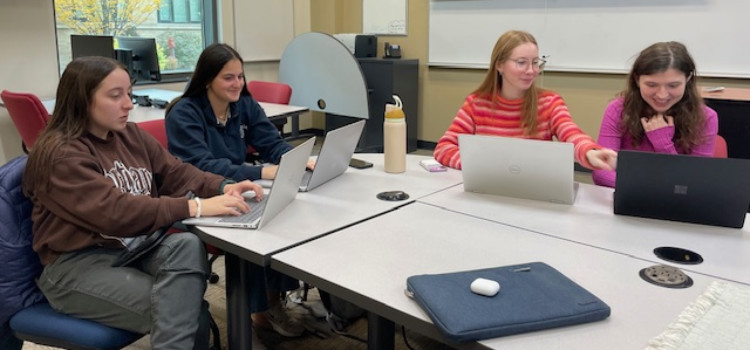
Engineers Jillian Berry, Drew Fitzpatrick, Abby Hidalgo and Isabelle May working on the platform
This manual procedure became a bottleneck that severely restricted the growth potential of VDI. Luckily, a group in Gonzaga University's Engineering Senior Design Project decided to design a solution. These four engineers— Jillian Berry, Drew Fitzpatrick, Abby Hidalgo, and Isabelle May— designed and programmed an automated matchmaking platform. After implementing the platform, the VDI Network reported major improvements in the management of course matching.
The success of this platform reflects the interdisciplinary vision of Dr. Rebecca Stephanis, a faculty member in the Department of Modern Languages and Literatures at Gonzaga University. She recognized that the operational needs of an intercultural network could double as a learning experience for engineering students— recasting a practical challenge as a pedagogical opportunity.
This experience embodies a core ideal of Jesuit education: professional excellence in service of others. The platform these students created will support intercultural learning for tens of thousands of peers across the hemisphere, a contribution that will outlast their time in the classroom.
Related Posts:
The Jesuit Universities Humanitarian Action Network (JUHAN) is pleased to announce an upcoming Encounter in Rome. Through this project, JUHAN hopes to promote their goals of advancing both undergraduate humanitarian education and the professional field of humanitarian action.

While we can look to the past with gratitude for all that has been accomplished in the history of each of your educational institutions, we are also well aware of the multitude of challenges facing humanity today. Indeed, our time has called an age of epochal change. Societies are becoming even more secularized, with many seeking to push any mention of God out of the public sphere and beyond popular culture.

On May 27, 2026, the extension course "Environment, Corruption" got underway, an academic initiative that's part of a broader international research project looking at the impacts of socio-environmental corruption across Latin America and the Caribbean. The course is led by AUSJAL together with social centers tied to the Society of Jesus, with the goal of encouraging critical reflection, knowledge-sharing, and stronger community capacity to confront this issue.
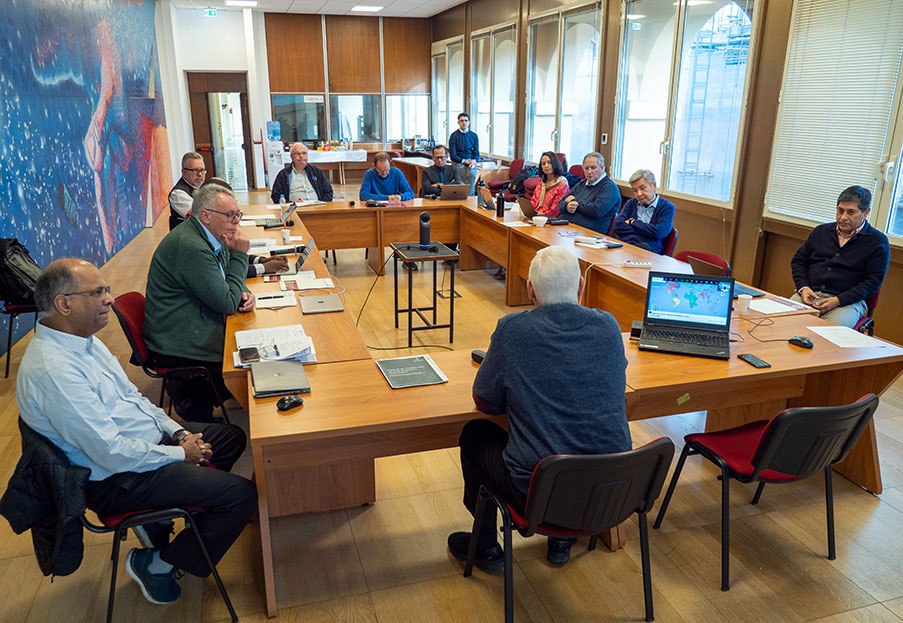
On 30-31 March 2026, the Board of the International Association of Jesuit Universities (IAJU) met at the General Curia in Rome to review the ongoing implementation of the Strategic Agenda (2024-2028) and the priorities defined at the Assembly in Bogotá in July 2025. At that Assembly, leaders from around the world identified six major challenges at the global level: democracy and global citizenship, student mental and spiritual health, secularization, Artificial Intelligence, migration and refugees, and environmental justice, along with a call to concretely increase collaboration among institutions.

Scholars, researchers, and academic leaders from Jesuit universities around the world gathered from 9 to 12 March 2026 at the Ateneo de Manila University for the Inaugural Symposium of the Global Research Alliance of Jesuit Universities (GRAJU), marking a major milestone in global collaboration among Jesuit institutions of higher education.
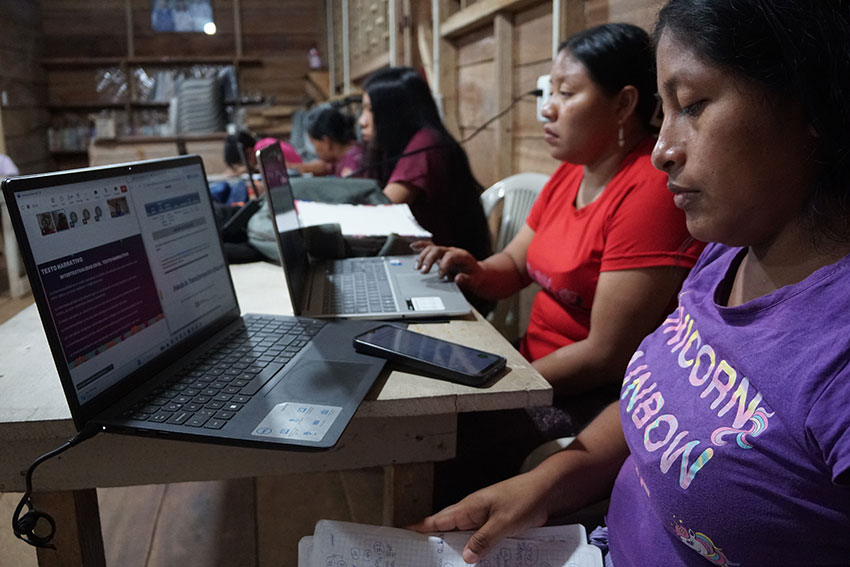
This six-month short-cycle tertiary programme, accredited (in Spanish) by the Pontificia Universidad Javeriana Cali, is designed to address the needs of communities all over the world to promote responsible tourism that allows the generation of income, while preserving the community’s fragile resources.