
The Origin of the Society of Jesus
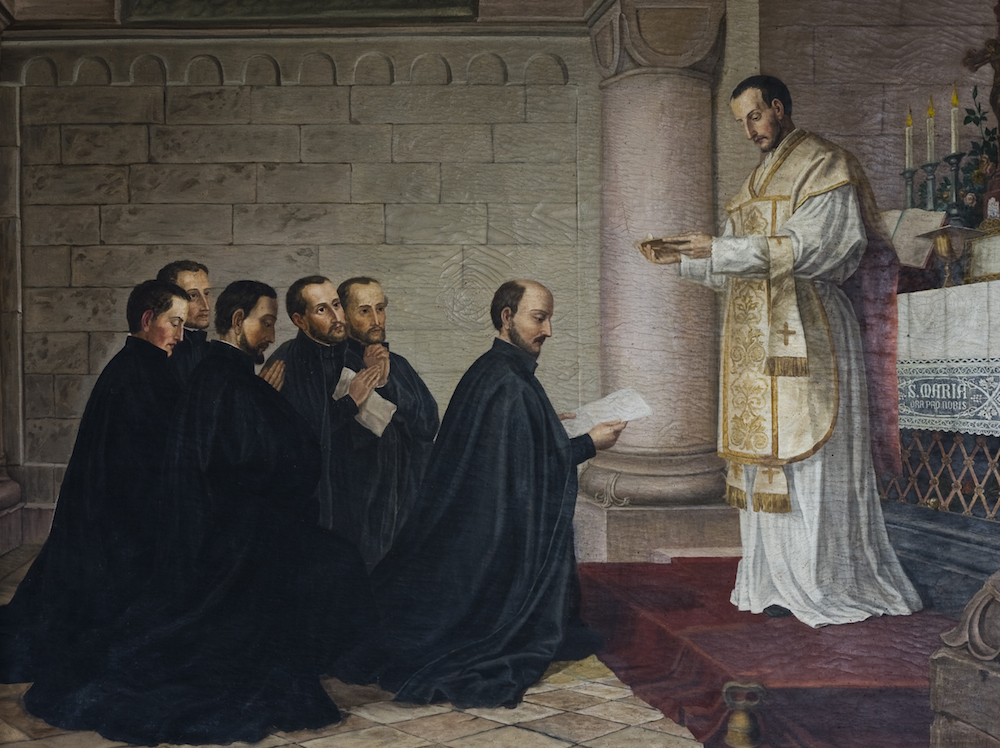
Ignatius and the First Companions making their first vows at Montmartre.
The Society of Jesus was founded by St. Ignatius of Loyola in the mid 16th century.
Ignatius originally planned to be a soldier but, after a brutal injury to his leg in 1521, he underwent a conversion to Christ that led him to his mission of “helping the souls.” In 1534, he completed his formation in Sorbonne, Paris. There, through the Spiritual Exercises, he attracted some University students to Christ, with whom he decided to create a group that would become the kernel of a new religious order: the Society of Jesus (the Jesuits).
The Society of Jesus was approved by Pope Paul III in Rome in 1540. It was designed to“serve God and the Church under the Roman Pontiff by means of different ministries: confessions, masses, spiritual exercises…”along with helping the poor.
The Centrality of Education to the Society of Jesus
The Society of Jesus did not originally include education among its founding purposes, but it soon realized that it needed members with solid training to fulfill its apostolic mission. This led to the creation of Jesuit “Colleges”, communities of learning for Jesuit candidates in pre-existing, non-Jesuit universities. Between 1540 and 1544, Jesuit Colleges were created in universities across France, Italy, Portugal and Spain.
Although these colleges were originally designed solely for Jesuit students, they progressively opened to non-Jesuit students, which gave birth to what is today known as schools... and universities.
The Evolution of Jesuit Universities
Overtime, it became apparent to the Jesuit leaders that higher education was a large way in which they could be of service to their communities. Over the course of nearly 500 years, Jesuit colleges have transformed from a place of religious formation to universities that are open to religious and non-religious people.
These universities are centers of premium education but also have a deeper mission: teaching, creation of knowledge (research) and a broader influence in society. This third dimension receives different names: “social debate”, “advocacy”, “social transformation”, etc. It depends on the influence of each university within its social context: by disseminating knowledge, and by partnering with other institutions to positively influence powerful actors that are shaping social structures.
The Founding of the IAJU


Up until 2018, the Secretariat of Education over saw both Jesuit Higher Education and Secondary Education. However, as the mission of Jesuit Universities expanded past just education, it was thought best to have a separate entity that oversaw Jesuit Higher Education. This sparked the creation of the International Association of Jesuit Universities (IAJU), which was approved by Fr. General Arturo Sosa at the 2018 World Assembly of Jesuit Universities.
The IAJU Today
Since its founding, the IAJU has grown into a global network coordinating Jesuit higher education across the six regional associations — AJCU-AP, AJCU, AJCU-AM, the Kircher Network, JHEASA, and AUSJAL — spanning the globe. The Association convenes international assemblies where Jesuit university leaders discern the future of Jesuit higher education, and supports collaborative programs which engage students and institutions worldwide.
Guided by its founding priorities, the IAJU continues to advance quality higher education for the marginalized and disadvantaged, promote civic and political leadership grounded in Catholic Social Teaching, and advocate for economic and environmental justice.