Jesuit Universities Boosting their Responses to Address the Environmental Crisis
By Nancy C. Tuchman, Michael J. Schuck and Christine Wolff, Loyola University Chicago
Pope Francis raised climate change to global consciousness as the defining moral issue of our time. As a result, the Church has become a global voice urging political accountability and personal responsibility for healing the planet. Building on his legacy, Pope Leo vigorously calls for urgent climate action and emphasizes reimagining nature not as an object to be dominated, but a respected participant in a reciprocal relationship with humanity. This challenge is set within a framework called ‘Integral Ecology’, drawing attention to both the scientific and social dimensions of today’s ecological crisis and engaging the whole person – morally and spiritually – into action-based responses.
Jesuit Higher Education is responding to these papal calls through education, advocacy, and more efficient campus operations. With a response rate of 63% among its 177 universities, the 2025 IAJU Eco-Social Inventory showed that 93% of the respondents were making progress with improvements in their institutional operations and physical plants. Additionally, 89% of Jesuit universities support environmental sustainability co-curricular activities.
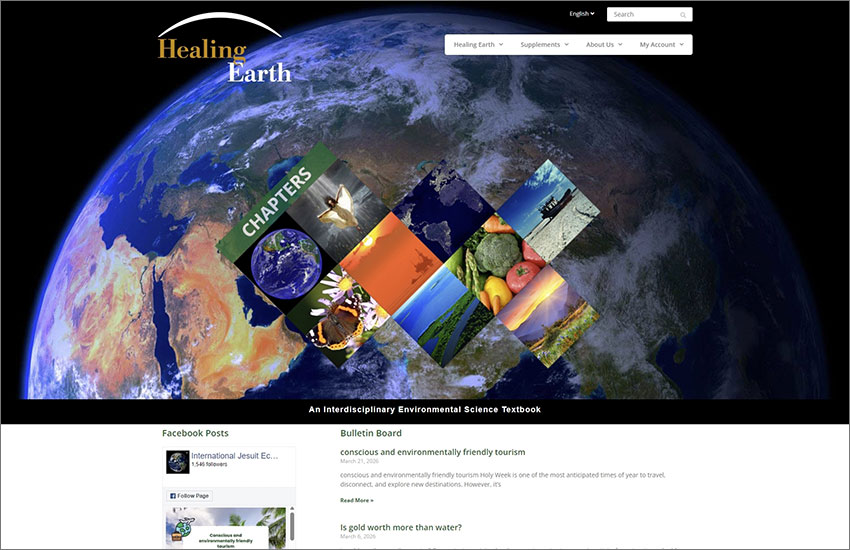
The homepage of the Healing Earth website
However, environmental education lags behind in our universities. Only 69% of Jesuit university respondents have developed formal courses, academic programs, departments, or schools of environment, indicating a significant gap in academic integration of environmental topics. Within the 69% are several exemplary institutions including Pontificia Universidad Javeriana in Bogotá, Colombia; Ateneo de Manila University in Quezon City, Philippines; ESADE in Barcelona, Spain; and Loyola University Chicago in Chicago, Illinois, USA.
Jesuit colleges and universities have a responsibility to ensure that educational programming across the university incorporates environmental awareness in an Integral Ecology framework. In this era of mounting environmental challenges, it is unacceptable for any Jesuit university to graduate students who lack exposure to this existential crisis. Each university must review and revise curricula so all graduates are equipped with the knowledge and values necessary for ecological citizenship.
The IAJU Task Force on Integral Ecology has developed two specific tools that are both free and extraordinarily useful in moving institutional operations, advocacy, and educational programming into greater engagement with today’s environmental challenges.
1) University Pathways guides universities in developing sustainability plans using the seven Laudato si’ goals set by Pope Francis in 2020, articulated on the Vatican’s Laudato si’ Action Platform (LSAP). University Pathways is a toolkit contextualized by the stage of the university’s current efforts, the size and resources of the university.
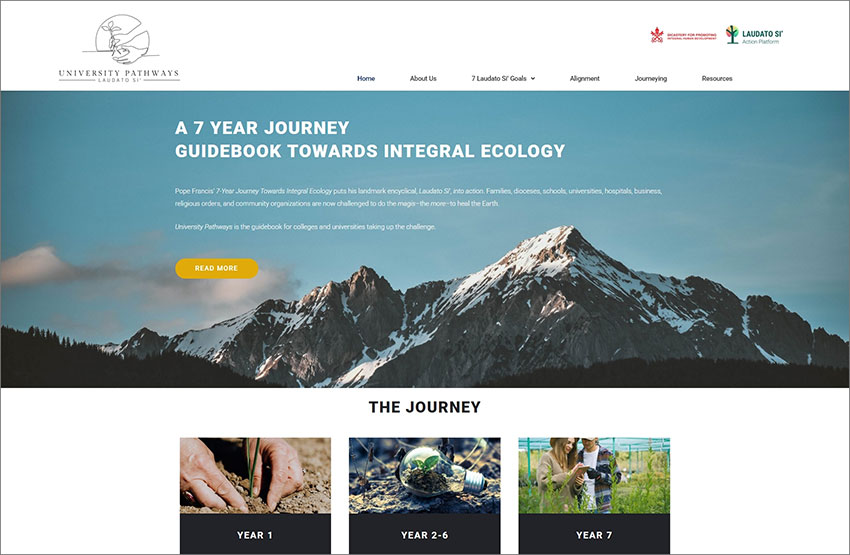
The homepage of the University Pathways website
2) Healing Earth is a free online environmental textbook addressing the critical environmental challenges in biodiversity, natural resources, energy, food, water, and climate change. Healing Earth utilizes an Integral Ecology framework to raise scientific awareness, prompt examination of ethical implications, encourage reflection on spirituality and the human relationship to the natural world, and inspire actions to heal the earth.
Healing Earth began at Loyola University Chicago following the release of a 2011 Society of Jesus Special Report, Healing A Broken World. The Report called on Jesuits and their lay companions to address environmental problems ethically, spiritually, and practically. Fr Michael Garanzini, SJ, then President of Loyola University Chicago, proposed the idea of creating a free, online textbook in environmental science, ethics, and spirituality that could be used by Jesuit universities and secondary schools around the world. He recruited Dr Nancy Tuchman, ecologist and former founding dean of Loyola’s School of Environmental Sustainability, and Michael Schuck, PhD, ethicist and professor of theology and environmental studies to develop his idea. In 2012 and 2013, Dean Tuchman and Professor Schuck gathered an international team of IAJU scientists, theologians, ethicists, and activists to develop the textbook.
Since its first release in 2015, Healing Earth has been translated into Spanish, Portuguese, French and Chinese, and is currently in its third edition. Over the past year alone, visitors to the Healing Earth website numbered over 36,035. Educators and students who had sustained, class engagement with the text was 11,500. Currently, 80 secondary school and university educators in 30 countries use Healing Earth as a main text, while many additional teachers take advantage of the textbook’s modular format, drawing single chapters or chapter sections into their standard presentations on environmental science, environmental justice, or eco-theology.
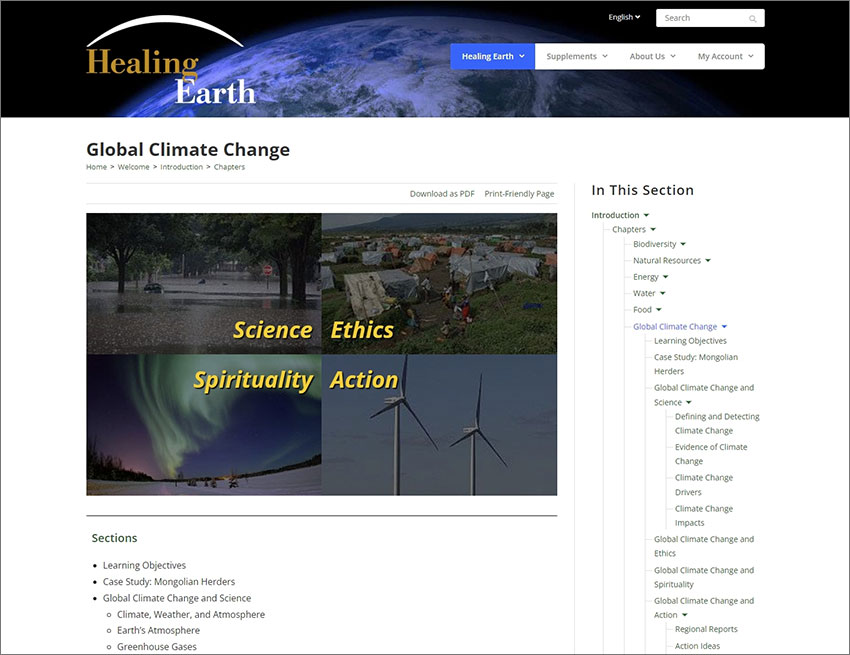
The initial page of the section “Global Climate Change” on the Healing Earth website.
In 2017, the Healing Earth team received the Expanded Reason Award from the Joseph Ratzinger-Pope Benedict XVI Vatican Foundation. The award honours academic projects that integrate scientific, theological and philosophic perspectives.
Healing Earth, developed over more than a decade through the dedication of Loyola University Chicago, has now been entrusted to the International Association of Jesuit Universities (IAJU) – a recognition of its global reach and its importance to the whole Jesuit higher education network. Its ongoing operation is now a shared responsibility across several Jesuit institutions that generously contribute their expertise and resources – from server hosting to technical maintenance and content development.
As part of this transition, Healing Earth is actively seeking partners from within the IAJU network to collaborate in the management, updating, and expansion of its content. If your university is interested in playing a role in keeping this living resource relevant and impactful for the global Jesuit educational community, we warmly invite you to get in touch.
We encourage you to advance your university’s commitment to environmental sustainability and justice by engaging the University Pathways toolkit and getting involved with Healing Earth. To engage with us, please reach out at [email protected].
Related Posts:
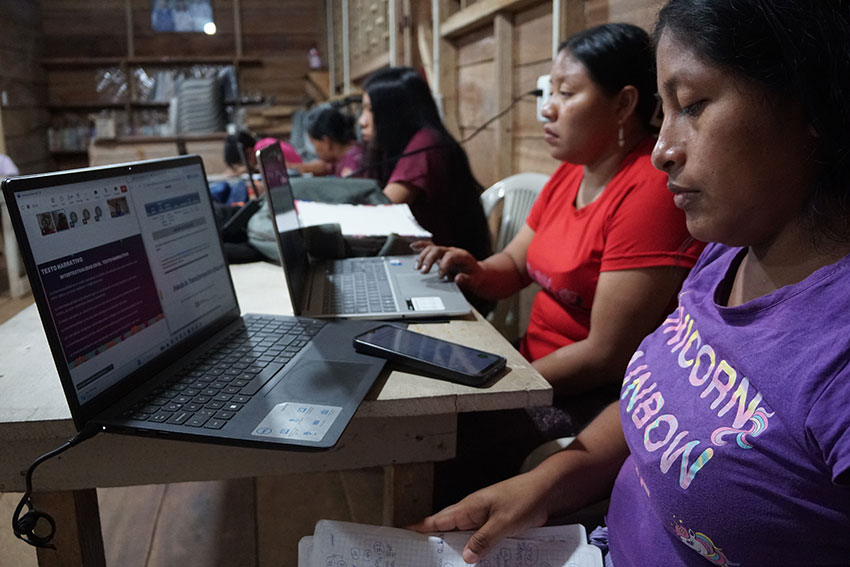
This six-month short-cycle tertiary programme, accredited (in Spanish) by the Pontificia Universidad Javeriana Cali, is designed to address the needs of communities all over the world to promote responsible tourism that allows the generation of income, while preserving the community’s fragile resources.