Chilean Music in Germany: Jesuit Institutions Preserving Culture
In February 2026, the Music Institute from Universidad Alberto Hurtado (UAH), located in Chile, collaborated with the Franz Liszt Conservatory of Weimar, Germany, to bring Chilean art song to Germany. This event strengthened inter-regional ties, and reaffirmed UAH’s promise to promote intercultural dialogue and understanding through music.
UAH and the Franz Liszt Conservatory have worked together for six years. As part of this collaboration, the Conservatory and UAH offer exchange programs with music courses for their students, with many students’ tuition being covered by the Ibáñez Atkinson Foundation. In early 2025, members of the Conservatory visited UAH and were fascinated by the Chilean music that was performed with German lyrics. After this visit, the Conservatory communicated with Gonzalo Cuadra and Gonzalo Simonetti, professors at the UAH Music Institute.
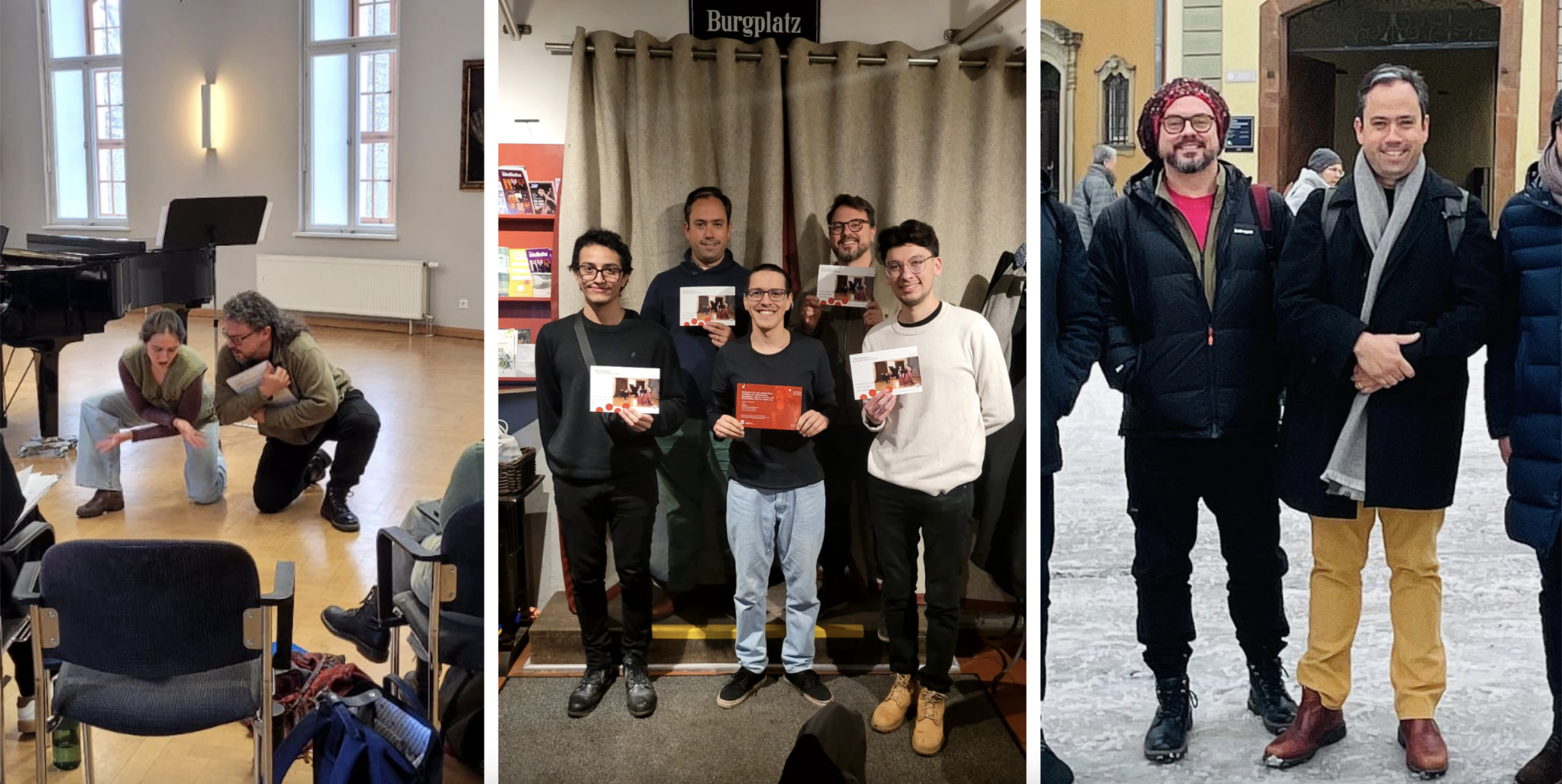
The product of this collaboration was a historic concert at the Conservatory, dedicated entirely to Chilean art song. In preparation for this event, the Weimar Conservatory dedicated an entire semester to the study of Chilean art songs, as part of a course that explores the tradition of this genre in various countries and which, on this occasion, was dedicated for the first time to a Latin American country. Through this course, the students were introduced to and learned about the lives and music of Chilean composers such as Carmela Mackenna, Alfonso Montecinos, Federico Heinlein, and Alfonso Leng, among others. For many students, this was their first contact with Latin American music in an institutional setting.
As part of the program, Cuadra and Simonetti conducted specialized classes and talks. These masterclasses supported the training process prior to the concert but also gave the Conservatory students the opportunity to learn about Latin American musical history and art from Latin American professors. These sessions brought together eight singers and four pianists from six countries, who spent the semester preparing the program that was presented to the German audience.
Cuadra and Simonetti also met with authorities from the German institution, including Christoph Ritter, director of the vocal area, and Jens Ewen, vice president of the institute. These meetings promoted conversation about the necessity of cultural exchanges between institutions, thus strengthening their academic collaboration.

The culmination of this exchange took place on February 10th, 2026, when the twelve musicians took the stage at the Franz Liszt Conservatory and performed a specialized curation of Chilean songs that were historically and aesthetically linked to Germany.These compositions were from a range of composers with different backgrounds that somehow tied them to both Chile and Germany.
“[The pieces] were created by German composers who spent time in Chile, by Chilean composers who wrote in German, and by prominent Chilean composers who lived in Germany,” Cuadra said.
This concert was part of a project led by the UAH Music Institute calledAnthology of Chilean Art Songs, which aims to recover and preserve the country’s musical heritage in the art song genre by recording songs annually under a specific theme and hosting that material on a website alongside the published sheet music for the songs, as well as performance aids consisting of biographies of the composers, contextual information, translations, and phonetic transcriptions of the lyrics, along with performance tips. Thus, the songs performed at this concert, held in February in Weimar, will soon be available to listen to on the anthology’s website.
This program acted as a bridge between institutes, but more than that, it created a space for an art form usually confined to its region to be shared across the world and studied in a formal setting.
Related Posts:
In the past eight years, the MAGIS Exchange program has impacted the lives of people all around the globe. They have operated in six regions worldwide, with a total global network of 42 Jesuit universities. Through this collaboration, the program has trained 207 students on important topics such as the Replicable Global Environmental Citizenship Course (GECC).

On 30-31 March 2026, the Board of the International Association of Jesuit Universities (IAJU) met at the General Curia in Rome to review the ongoing implementation of the Strategic Agenda (2024-2028) and the priorities defined at the Assembly in Bogotá in July 2025. At that Assembly, leaders from around the world identified six major challenges at the global level: democracy and global citizenship, student mental and spiritual health, secularization, Artificial Intelligence, migration and refugees, and environmental justice, along with a call to concretely increase collaboration among institutions.

Scholars, researchers, and academic leaders from Jesuit universities around the world gathered from 9 to 12 March 2026 at the Ateneo de Manila University for the Inaugural Symposium of the Global Research Alliance of Jesuit Universities (GRAJU), marking a major milestone in global collaboration among Jesuit institutions of higher education.
The conveners of ten working groups of the International Association of Jesuit Universities (IAJU) met for the first time in Rome from December 15 to 16 with the aim of fostering collaboration and aligning efforts towards a common vision: Jesuit universities as agents of social transformation in a world that desperately needs it.

This past August, the Jesuit commitment to the Universal Apostolic Preferences came to life through an inspiring global initiative connecting two continents. The Xavier Institute of Engineering (XIE) in Mumbai, India, and the Xavier Jesuit Institute (XJI) in Ijebu-Ode, Nigeria, joined forces once again to deliver Joy of Python—a program designed to expand educational opportunity and help close the digital divide in the Nigerian cities of Benin City and Lagos.

A New Research Chapter Begins: Launch of the Global Research Alliance of Jesuit Universities (GRAJU)
In August 2025, seven Jesuit universities came together to launch a landmark initiative: the Global Research Alliance of Jesuit Universities (GRAJU). Founded by Ateneo de Manila University (Philippines), Fordham University (USA), Georgetown University (USA), ITESO (Mexico), Sogang University (South Korea), the University of Deusto (Spain), and Namur University (Belgium), GRAJU marks a bold step toward deepening global research collaboration within the Jesuit higher education network.