Creating jobs, not looking for them: Jesuit universities champion African entrepreneurship
As part of their international collaboration, Jesuit universities in Africa, Europe, and the United States have joined forces to promote entrepreneurship across Africa. Universidad Loyola Andalucía, the Université Loyola du Congo, and the Kosyam Jesuit University of Science are launching “Laying the Foundations for African Entrepreneurship Hubs,” a project co-funded by the John Templeton Foundation. The goal is to create innovation and business development hubs at Jesuit universities in Africa, supported by an international network of entrepreneurship centers.

A Network of Sister Universities
The project rests on a shared conviction: collaboration among institutions is the primary path to creating opportunities. Each hub will serve as a space for training and mentoring business projects within the university. The center will offer training programs, incubate initiatives, provide access to mentors, and develop business models adapted to each country's local context.
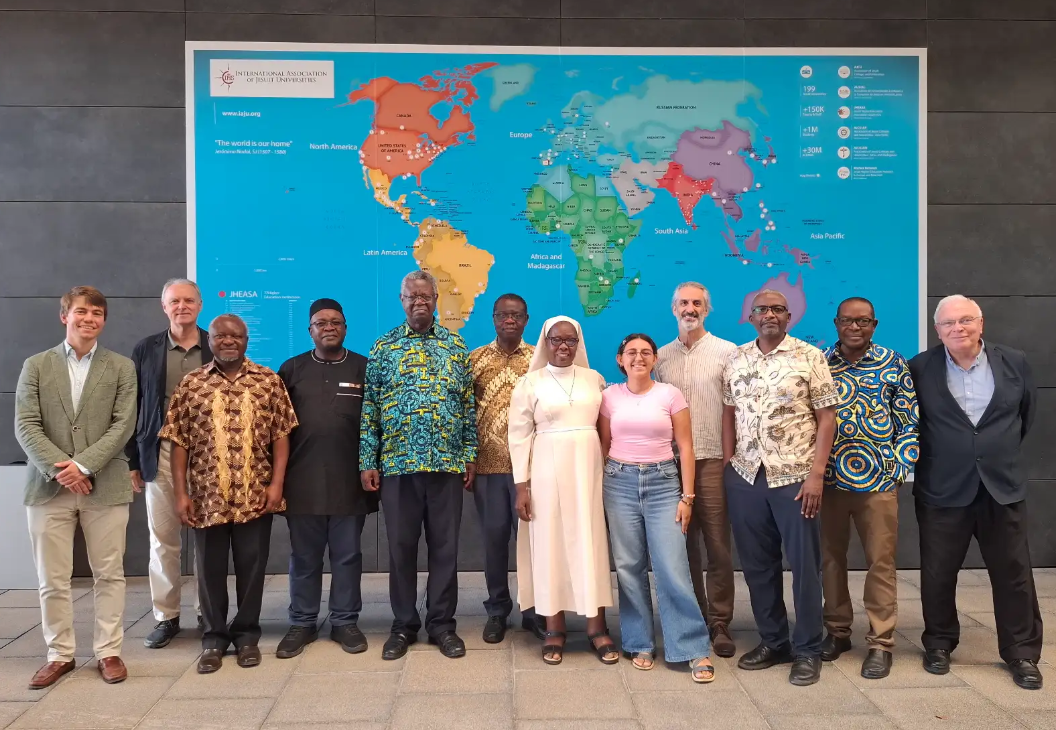
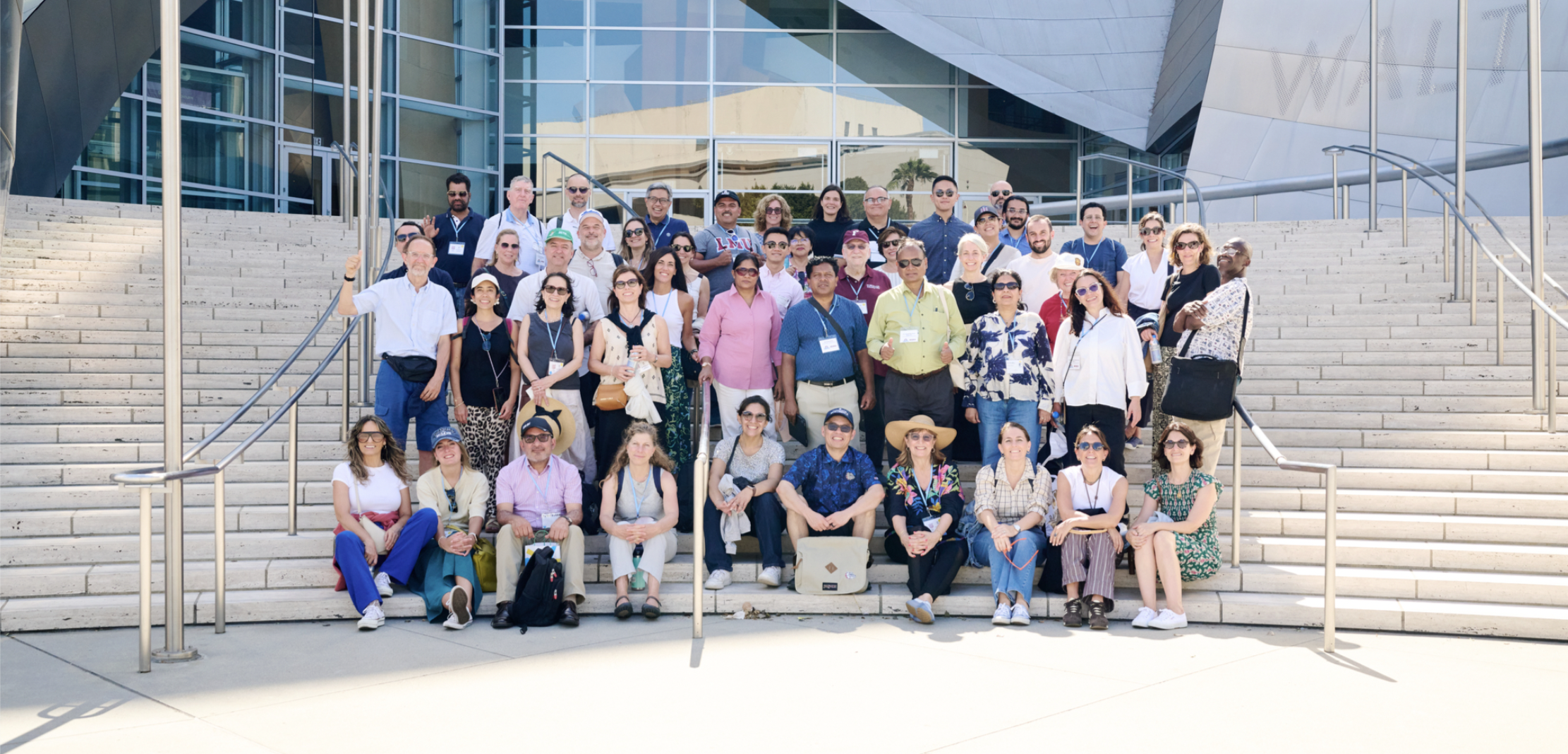
This initiative is the result of a journey that began in 2019. At that time, the Superior General of the Society of Jesus, Fr. Arturo Sosa, S.J., pointed to Universidad Loyola's privileged position as a bridge between Europe and the United States and highlighted a renewed commitment to inter-institutional work. In March 2025, Jesuit universities in Africa, meeting in Spain, identified entrepreneurship and economic development among their shared priorities.
As a result, the project is now oriented toward a concrete future. Its aim is to turn the enormous entrepreneurial potential of a very young population into employment and development. To achieve this, it is necessary to strengthen ecosystems that foster the emergence of solid, scalable business initiatives aligned with inclusive development principles.
“Training People to Create Jobs, Not to Look for Them”
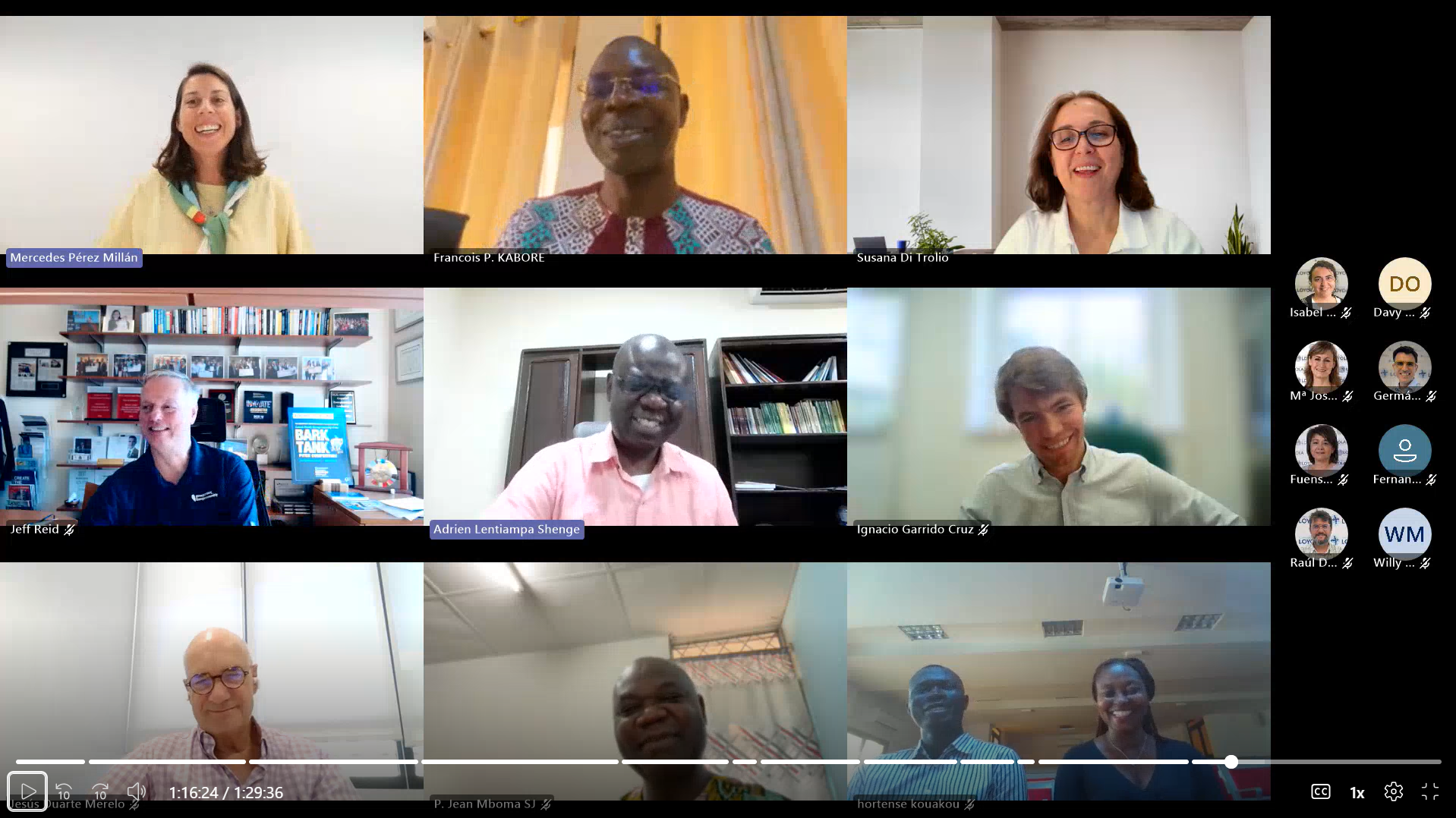
Representatives of the partner institutions took part in the online launch meeting, where they shared their visions and expectations. François Kaboré, S.J., rector of the Kosyam Jesuit University of Science and coordinator of the network of Jesuit universities in Africa and Madagascar, warned that official youth unemployment figures underestimate the reality of a continent rich in resources but marked by underemployment and the informal economy: “My hope is that our universities become places where people are trained to create jobs, not to look for them. What we seek with this project is to change mindsets, so that young people understand that they can also be trained to become job creators,” he said. Kaboré also recalled the MBA program he launched in Abidjan in 2015, which is now on its eleventh cohort and has trained entrepreneurs who today are creating jobs.
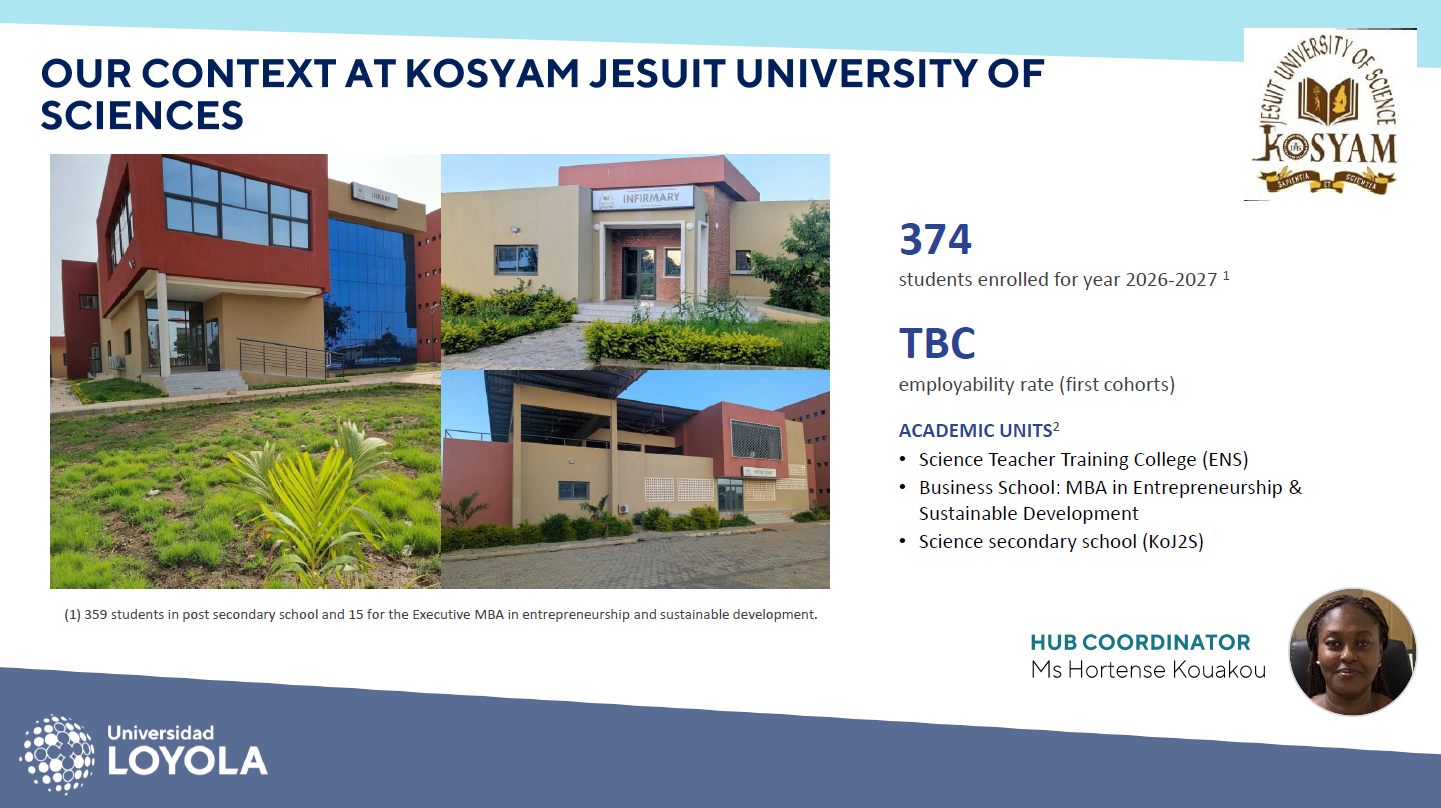
In Burkina Faso, Hortense Kouakou, coordinator of the Kosyam hub, explained that the center will serve as a bridge between university education and the business world. The country has a very young population and abundant natural resources, but entering the labor market remains a challenge.
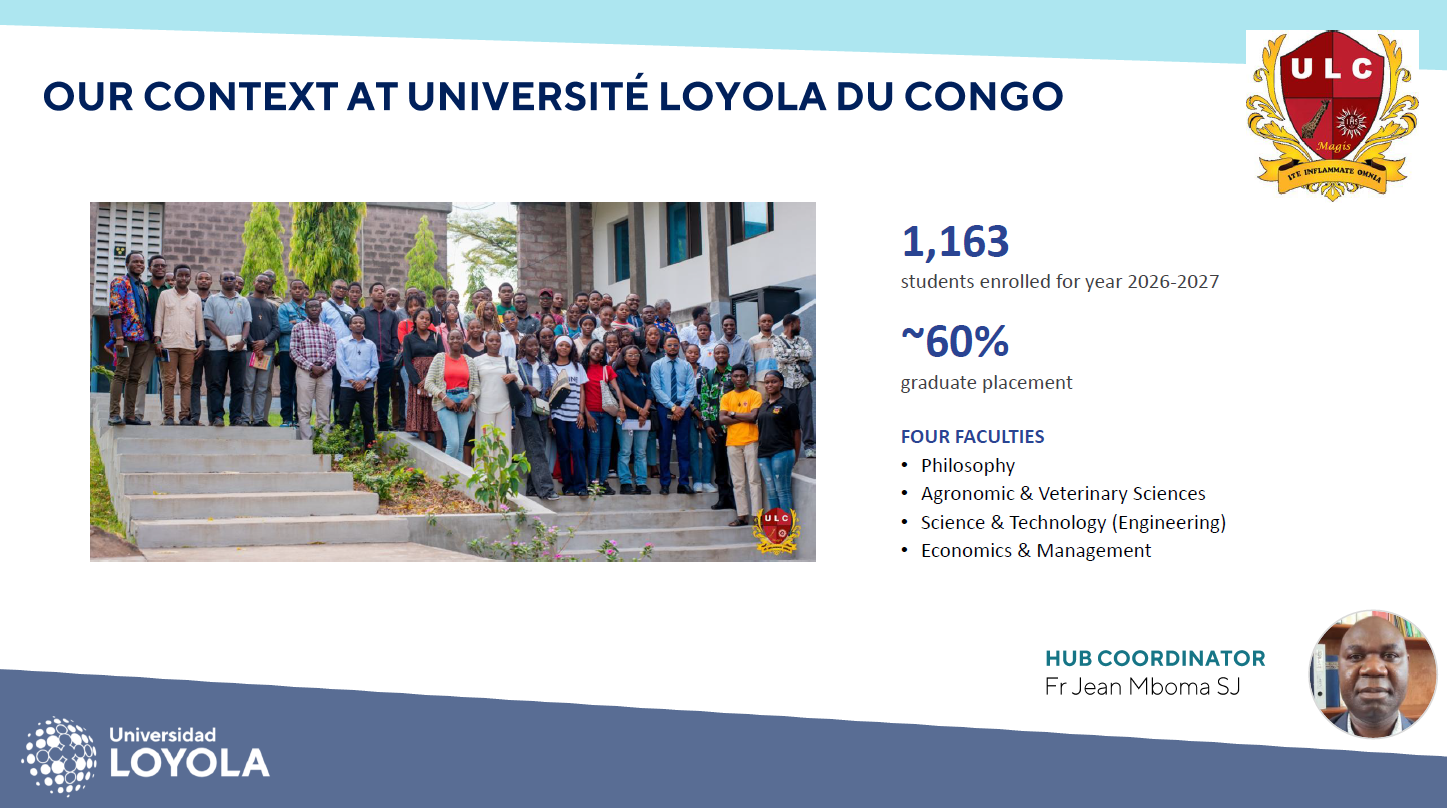
On behalf of the Université Loyola du Congo, its rector, Adrien Lentiampa, S.J., gave the floor to Fr. Jean Mboma, S.J., coordinator of the hub in Kinshasa. “Our country is very rich, but with many poor people. For me, entrepreneurship is a way out of poverty: we have many opportunities, but they remain just that, opportunities. We need people with initiative, who believe in their own talent and who want to create businesses founded on values,” he said. Mboma expressed his wish that the hub become a meeting place from which young people emerge equipped to transform society, taking advantage of opportunities such as the major economic corridors being developed in the country.
The Vice-Rector for Learning and Internationalization at Universidad Loyola, Javier Nó, emphasized the spirit of collaboration among peers: “Our sister universities in Kinshasa and Ouagadougou are leading something important, and we want to be part of it. We share the conviction that education should open doors, and one of the best ways to do so is to help young people create the work their communities need”. Nó expressed his hope of seeing “two vibrant entrepreneurship centers, rooted in their own context,” and that the project will strengthen the friendship among the institutions beyond this initiative.

Principled Entrepreneurship
Gregory Wolcott, director of the Individual Freedom and Free Markets area at the John Templeton Foundation, explained the approach of “principled entrepreneurship” that inspires the project. “Not all entrepreneurship is ethical. Many educational programs simply say: ‘generate impact, do something good for the world.’ It sounds good, but it is not enough: how we pursue our goals also matters,” he stated.
Wolcott stressed the importance of training entrepreneurs who create value while respecting the rules of the game, without seeking favors or resorting to corruption. He also noted that this approach complements the principles of the Church's social doctrine: the dignity of the person, the common good, solidarity, and subsidiarity. Regarding the grant, he clarified that it is planning support, intended to allow the team and its African partners to experiment, learn, and find out what works and what does not.
A Global Support Network
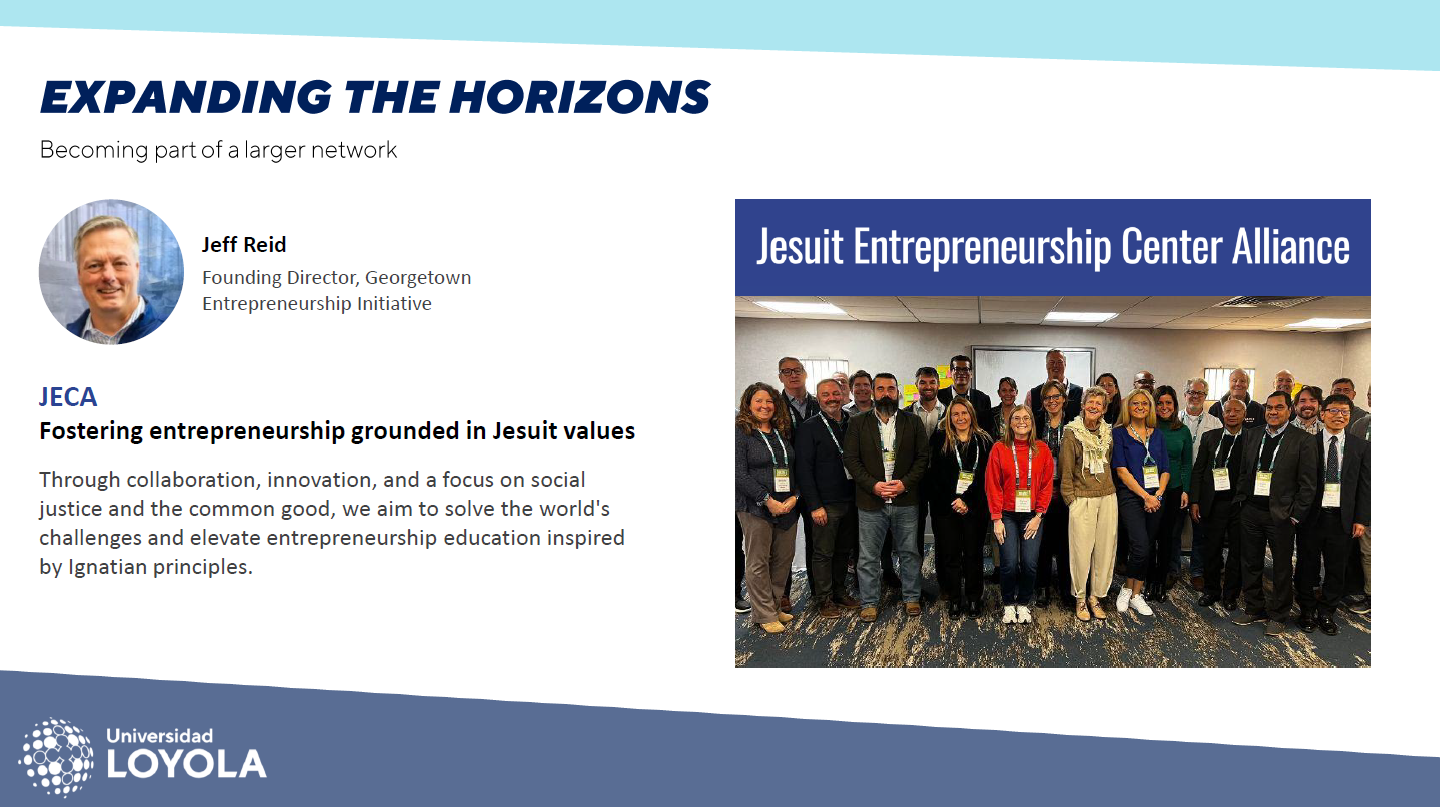
The two African universities are also joining the Jesuit Entrepreneurship Center Alliance (JECA), the international network of entrepreneurship centers at Jesuit universities, led by Georgetown University and Loyola University Maryland. Jeff Reid, director of Georgetown’s entrepreneurship center and a driving force behind the alliance, said the network is mobilizing to support the new hubs, with the humility of those who know each place's context is decisive.
JECA will hold its annual meeting in Seville in July 2027. There, leaders of entrepreneurship centers from North America, Asia, and other regions will meet with their African colleagues. The project will also draw on the collaboration of UNIJES universities and the Kircher Network, allies of our Jesuit network, to share best practices.
Next Steps
The pilot phase will last two years and will be coordinated by Universidad Loyola. It will initially be implemented at two institutions: the Université Loyola du Congo (Democratic Republic of the Congo) and the Kosyam Jesuit University of Science (Burkina Faso). In the medium term, the initiative aims to consolidate a network of entrepreneurship hubs across seven Jesuit universities in Africa, thereby contributing to the training of a new generation of young entrepreneurs.
Related Posts:

On 30-31 March 2026, the Board of the International Association of Jesuit Universities (IAJU) met at the General Curia in Rome to review the ongoing implementation of the Strategic Agenda (2024-2028) and the priorities defined at the Assembly in Bogotá in July 2025. At that Assembly, leaders from around the world identified six major challenges at the global level: democracy and global citizenship, student mental and spiritual health, secularization, Artificial Intelligence, migration and refugees, and environmental justice, along with a call to concretely increase collaboration among institutions.

Scholars, researchers, and academic leaders from Jesuit universities around the world gathered from 9 to 12 March 2026 at the Ateneo de Manila University for the Inaugural Symposium of the Global Research Alliance of Jesuit Universities (GRAJU), marking a major milestone in global collaboration among Jesuit institutions of higher education.

This past August, the Jesuit commitment to the Universal Apostolic Preferences came to life through an inspiring global initiative connecting two continents. The Xavier Institute of Engineering (XIE) in Mumbai, India, and the Xavier Jesuit Institute (XJI) in Ijebu-Ode, Nigeria, joined forces once again to deliver Joy of Python—a program designed to expand educational opportunity and help close the digital divide in the Nigerian cities of Benin City and Lagos.

Jesuit university leaders from across the globe to gather in Bogotá to discern the future of Jesuit higher education in response to the world’s greatest challenges

Loyola University hosted a working session at its Seville campus with rectors and senior leaders from the institutions of the Association of Jesuit Colleges and Universities in Africa and Madagascar (AJCU-AM). These sessions built on prior meetings held throughout 2024 in the Democratic Republic ofthe Congo, Burkina Faso, Kenya, and Zimbabwe, which gradually shaped a group of institutions aroundan initial proposal of collaboration. The program provided a space to exchange ideas about the structure of the group,identify priority areas for collaboration, and explore funding opportunities for joint international projects.

In response to the need for Africans to take ownership of their history, the Jesuit Historical Institute in Africa (JHIA) was founded in 2010 by Fr. Adolfo Nicolás, S.J.